


If you run a small warehouse, workshop, yard or office, legionella can feel like a problem for hospitals and hotels. It isn't. Any hot and cold water system at work needs its risk assessed and controlled, and for most small sites the controls come down to a handful of routine checks. The checks are easy. Keeping a record that shows they were done, every week and every month, is where most sites slip.
try free for 30 days
Get your safety checks off paper in a day
Free for 30 days, no card needed

Quick start
Who is responsible, and for what
Legionella bacteria grow in water between about 20°C and 45°C, especially where water sits still. People catch Legionnaires' disease by breathing in fine droplets, from showers and spray taps for example.
Under health and safety law, an employer, or anyone in control of premises, has to assess and control that risk. HSE's Approved Code of Practice, L8, and its technical guidance, HSG274, set out how. HSG274 Part 2 covers hot and cold water systems, which is what most small sites have. In practice, the duty holder needs to:
- have a risk assessment done by someone competent, and review it when anything changes;
- name a responsible person to look after the day-to-day controls;
- have a written scheme that says what is checked, how and how often;
- keep records of the checks and of anything done about them.
For a small site with a simple system, the risk assessment may well find the risk is low. That does not remove the need for checks. It usually means the controls are simple: keep hot water hot, keep cold water cold, and keep water moving.
TagPoint helps you keep the records of your water checks. It does not replace a legionella risk assessment or a competent person, and this article is not legal advice. Follow your own written scheme and HSE's L8 and HSG274 for the details of your system.The routine checks and how often
These are the routine checks HSG274 Part 2 describes for a typical hot and cold water system. Your written scheme may add others, such as an annual inspection of a cold water storage tank, or change the frequencies for your site.
| How often | Check | What good looks like |
|---|---|---|
| Weekly | Flush little-used outlets: taps and showers not used at least once a week | Each outlet run for a few minutes, and the flush recorded, including in empty rooms and during shutdowns |
| Monthly | Hot water at the sentinel outlets | At least 50°C within one minute of running the tap (55°C in healthcare premises) |
| Monthly | Cold water at the sentinel outlets | Below 20°C within two minutes of running the tap |
| Monthly | Calorifier or hot water cylinder flow and return | Flow at least 60°C, return at least 50°C |
| Quarterly | Shower heads and hoses | Dismantled, cleaned and descaled, or more often if they scale up quickly |
Sentinel outlets are the taps nearest to and furthest from each hot water heater or cylinder, and from the cold water tank or the incoming main. If the water is at the right temperature at those points, it is very likely to be right in between. Your risk assessment should name them; if it doesn't, ask the person who wrote it.
Little-used outlets are the ones that catch small sites out: the shower nobody uses in winter, the sink in a storeroom, the toilets in an empty unit. Either use them weekly, flush them weekly, or ask whether they should be removed altogether.
How to take a reading properly
A temperature check is only as good as the way it is taken.
- Use a calibrated probe thermometer, not your hand and not the boiler display.
- Put the probe in the flow of water and start timing when you open the tap.
- Write down the actual reading and the time it took, for example "51.4°C at 40 seconds". "OK" or a tick tells nobody anything.
- Note which outlet, using the same name every time, such as "first floor kitchen, hot".
- Record cold readings too, especially in summer, when cold water warms up in pipes running through warm spaces.
What you must record
HSE's L8 says records should be kept for at least five years. They should include:
- the name of the responsible person and of the people who carry out the checks;
- the significant findings of the risk assessment;
- the written scheme and how it is put into practice;
- the results of each check, monitoring and inspection, with the dates;
- details of any remedial work and when it was done.
Five years is a long time for a paper log. Pages get damp in plant rooms, books fill up and get replaced, and whoever did the checks three years ago may have moved on. The records that hold up are the ones that show the actual readings, the date and time, the person, and what happened when something was out of range.
When a reading fails
A hot outlet that only reaches 46°C, or a cold one at 23°C, is not an emergency in itself, but it should not be left in the log and forgotten. A sensible routine is:
- Run the outlet longer and re-check, in case it was a slow start.
- Record the failed reading anyway, with a comment about what you saw.
- Tell the responsible person the same day.
- Find and fix the cause, for example a heater setting, a failed valve or a dead leg of pipe, with competent help where needed.
- Re-test after the fix and record the new reading.
The weak point is almost always the hand-over. The person who takes the reading is rarely the person who can fix it, and on paper the failed reading sits in a book until someone happens to look.
Keeping the checks on schedule
Here is how small sites set up water checks in TagPoint.
A QR label at each sentinel outlet, on the wall beside it or inside the cupboard below. Scanning it opens the right check for that outlet. To check all sentinel outlets in one go, a walk-round check visits each point in order and shows how many are done.
Readings as numbers, with limits. Each temperature is entered as a number, with its limits set in the check, such as 50°C for hot and 20°C for cold. The checker enters the reading and answers whether it met the limit; a fail asks for a comment and a photo of the thermometer, and raises an issue for the person who looks after the water system, with a deadline.
Schedules with deadlines. Weekly flushing, monthly temperatures and quarterly shower head cleaning are set up as recurring checks, assigned to a person or a role. If one is not done in time, the manager is told, so a missed week shows up that week.
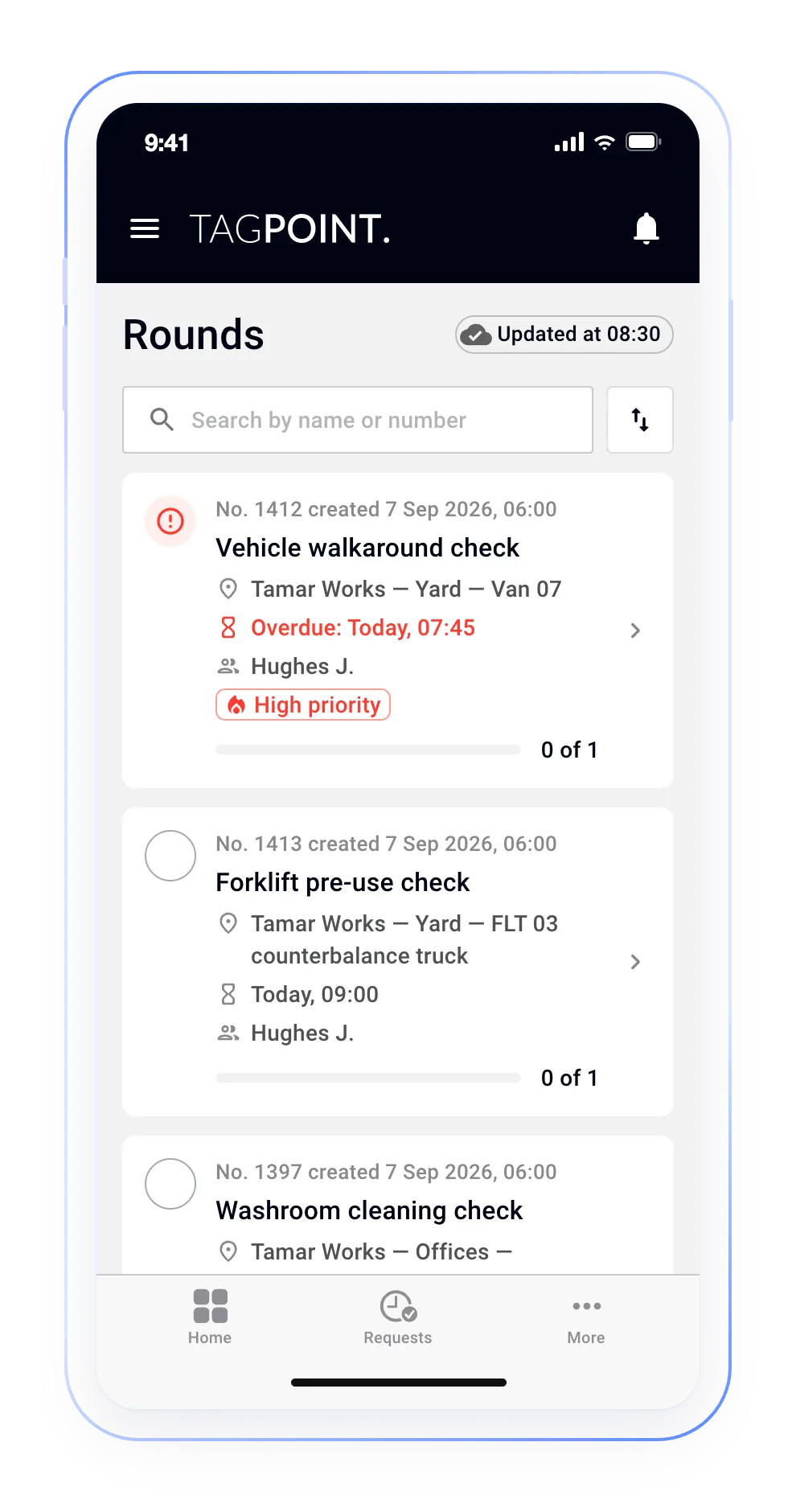
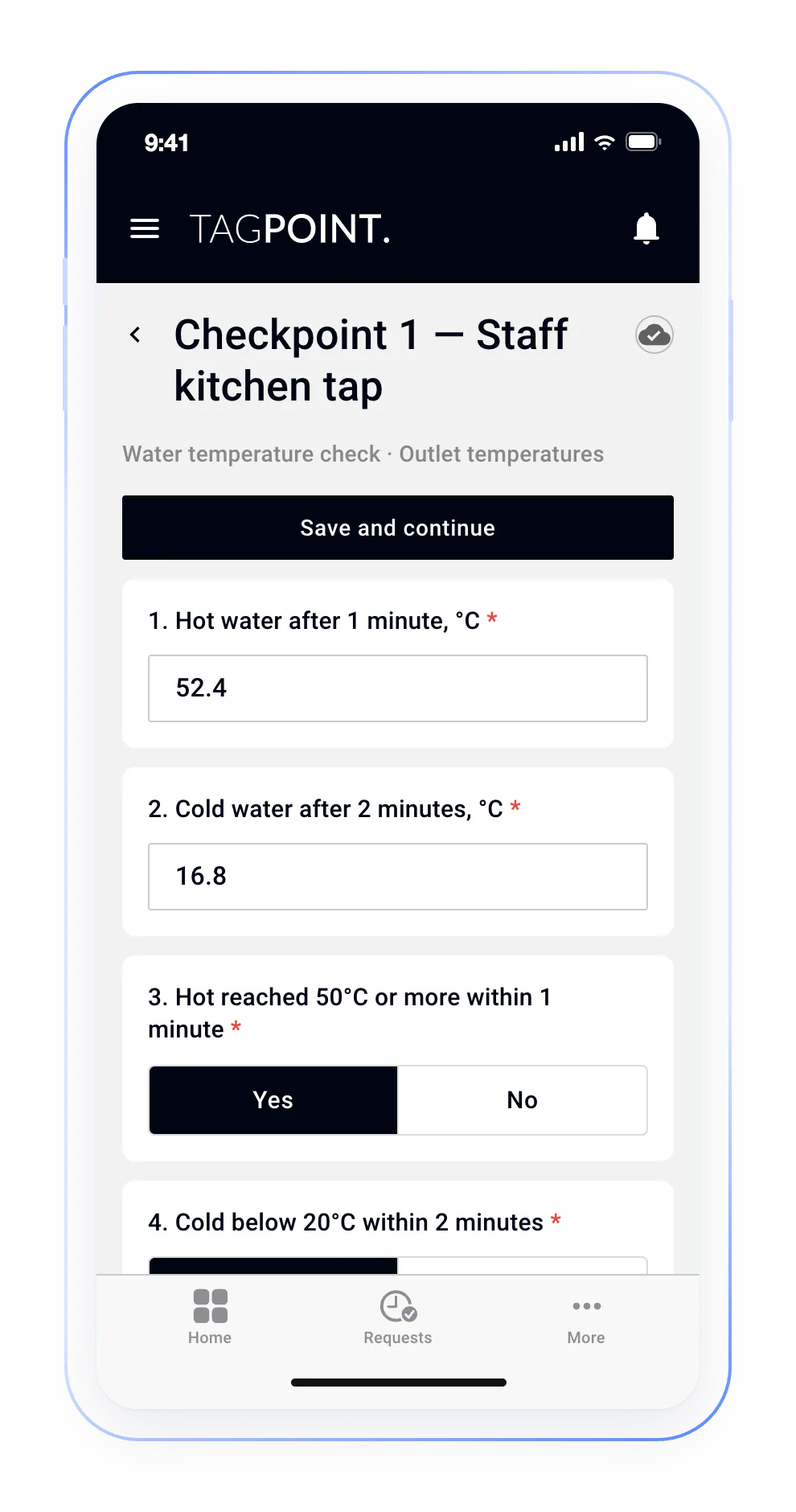
Today's checks for a staff member, and the monthly temperature check at one outlet
A record you can hand over. Every check is kept with the name, the time and each reading. Records stay in your account, you can print any check, and report tables export to Excel for your five-year file or for your water hygiene contractor.
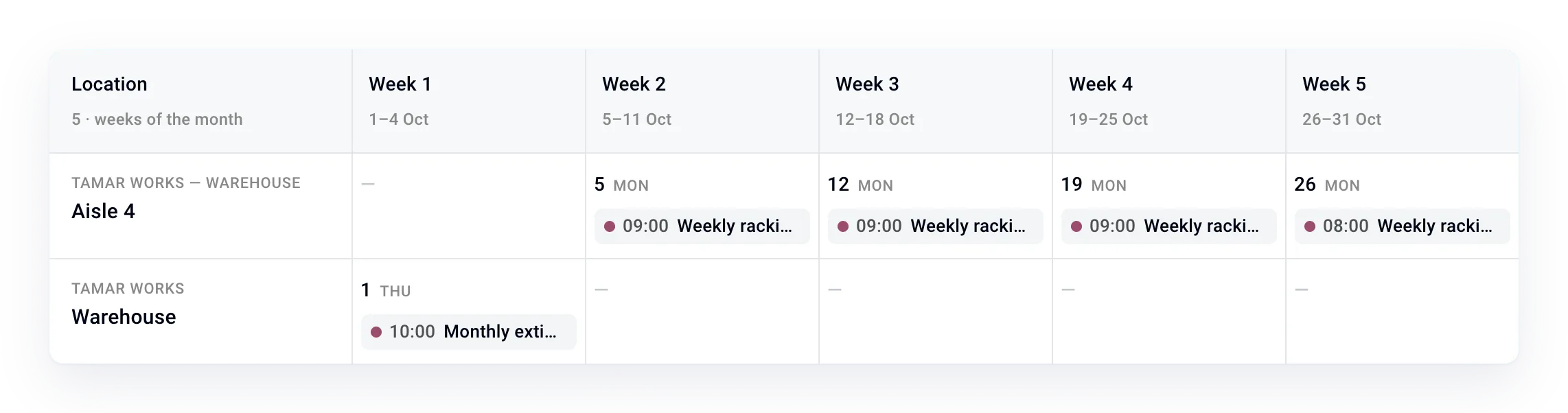
Weekly flushing, monthly temperatures and quarterly shower heads on one schedule
If you want to start on paper first, our free water temperature log has columns for the outlet, the reading, the time to temperature and the action taken. You can read more about legionella and water checks in TagPoint, or browse our other check templates.