


The Provision and Use of Work Equipment Regulations 1998, PUWER for short, apply to almost everything your people use at work: a pillar drill, a press brake, a conveyor, a pallet truck, a forklift. The regulations don't use the phrase "pre-use check", but short checks before use are one of the simplest ways to show the equipment is being kept safe. This guide explains the parts of PUWER that matter most on a small shop floor and how to run pre-use checks that actually catch faults.
try free for 30 days
Get your safety checks off paper in a day
Free for 30 days, no card needed

Quick start
The four PUWER regulations that matter most
PUWER has many regulations, but four of them drive most day-to-day checking.
Regulation 4, suitability. Equipment must be suitable for the job and for the conditions it is used in. A machine that was fine in a clean workshop may not be in a wet yard.
Regulation 5, maintenance. Equipment must be maintained in an efficient state, in efficient working order and in good repair. Where a machine has a maintenance log, it must be kept up to date.
Regulation 6, inspection. Where safety depends on how equipment is installed, it must be inspected after installation and before first use, and after it is reassembled somewhere new. Where equipment is exposed to conditions that cause deterioration which could lead to danger, it must be inspected at suitable intervals, and again after anything exceptional, such as a collision or a flood. The result of each inspection must be recorded and kept until the next one is recorded.
Regulation 11, dangerous parts of machinery. People must be prevented from reaching dangerous moving parts, or the parts must be stopped before anyone gets there. The order of preference is fixed guards where practicable, then other guards or protection devices such as interlocks, then jigs, holders and push-sticks, backed by information, instruction, training and supervision.
TagPoint helps you keep the record of each check and each fault. It does not make anyone compliant on its own, and this article is not legal advice. HSE's guidance on PUWER (L22) and LOLER (L113) sets out the requirements in full.Where pre-use checks fit
HSE's guidance describes inspection as anything from a simple visual check before use to a detailed inspection by a competent person, with the type and frequency set by the risk. A sensible set-up for a small manufacturer usually has three layers:
| Layer | Who | What it catches |
|---|---|---|
| Pre-use check, each shift or each use | The operator | Missing or loose guards, interlocks that don't stop the machine, damaged leads, leaks, warning lights |
| Periodic inspection, weekly to yearly | A trained supervisor or maintenance person | Wear and deterioration that a quick look won't show, recorded as PUWER regulation 6 requires |
| Thorough examination, where the law requires it | A competent person, often from your insurer or an inspection body | The detailed examination of lifting equipment under LOLER, pressure systems and similar |
The pre-use check is the cheapest layer and the one that runs most often. It is also the one most likely to turn into a tick-box habit.
Lift trucks: L117 and LOLER
Forklifts and other lift trucks get their own guidance. HSE's Approved Code of Practice L117, on rider-operated lift trucks, says operators should check their truck at the start of each shift and report any defects they find. Typical items are forks and mast, chains, hydraulic hoses and leaks, tyres, brakes and parking brake, steering, horn, lights and beacon, seat belt, controls, and the battery or LPG connection.
A lift truck is also lifting equipment, so the Lifting Operations and Lifting Equipment Regulations 1998 (LOLER) apply. It needs a thorough examination by a competent person at least every 12 months, or every 6 months if it is used to lift people. Lifting accessories, such as chains and slings, need one at least every 6 months. A written examination scheme drawn up by a competent person can set different intervals.
The thorough examination does not replace the start-of-shift check. The examiner sees the truck once or twice a year; the operator sees it every day.
What to check before use
A good pre-use check is short, specific to the machine and done by looking, not guessing. Here are typical items by type of equipment.
Fixed machines (lathes, saws, presses, press brakes):
- fixed guards in place and secure;
- interlocked guards stop the machine when opened;
- emergency stop works and resets correctly;
- no visible damage, leaks or loose parts;
- work area clear and well lit.
Conveyors:
- guards in place over drives, rollers and nip points;
- pull-cord or emergency stops work along the length;
- nothing caught or building up under the belt.
Portable power tools:
- casing, lead and plug undamaged;
- guard fitted and adjusted;
- switch works and returns to off.
Eight to fifteen questions is usually plenty. If your current sheet has fifty, nobody is reading most of them.
Our free forklift pre-use check and machine safety check templates are a good starting point.
What to record, and why
The law does not always require a quick pre-use check to be written down. Inspections under PUWER regulation 6 must be recorded, though, and a written pre-use check is the easiest way to show that faults are found and dealt with. A useful record has:
- the equipment, by name or number;
- the date, time and operator;
- a result for every item, not just the failed ones;
- details and a photo of any fault;
- a clear "safe to use?" answer;
- who was told, what was done and when it was closed.
The last line is the one paper rarely captures. A sheet that says "guard loose" proves the fault was known. Without a record of the repair, it also proves nobody can show it was fixed.
Making pre-use checks stick
This is how small manufacturers run pre-use checks in TagPoint.
One QR label per machine or truck, at the operator's position and outside any guarded area. The operator scans it with the TagPoint app and the check for that machine opens. Our article on where to put QR labels has examples.
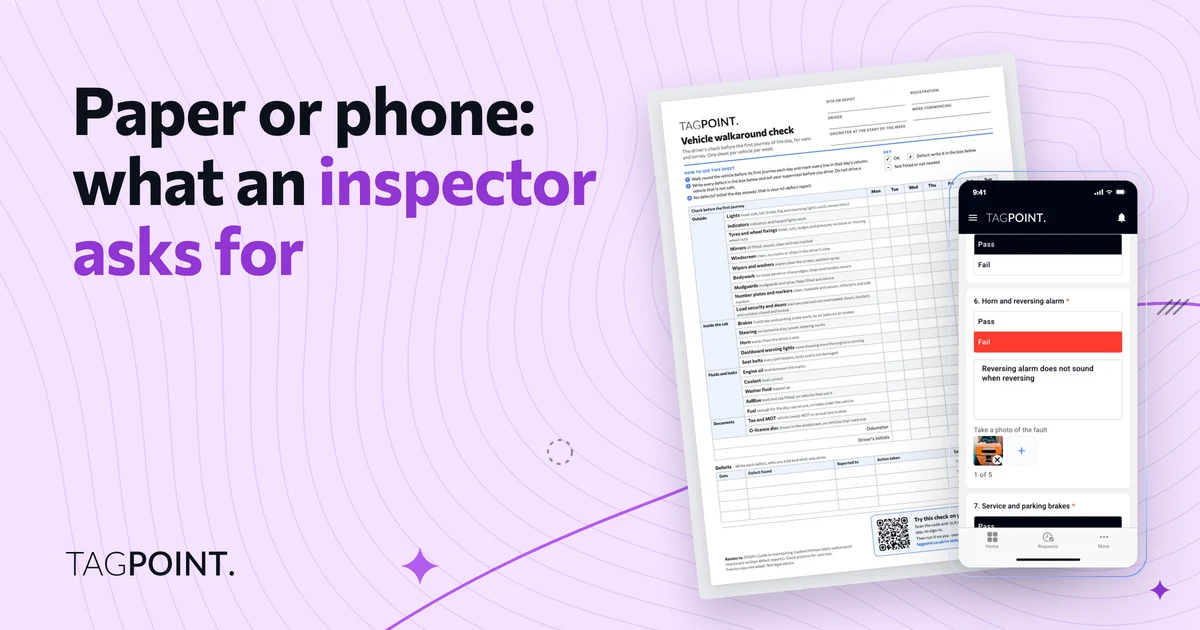
Pass or fail for each item. A failed item asks for a comment and a photo before the check can be saved. Hours or meter readings are entered as numbers with limits.
Every failed item raises an issue, assigned to maintenance, the supervisor or a named person, with a deadline. If it is not closed in time, the manager is told. The issue keeps its full history: who reported it, who fixed it, what they did and when.
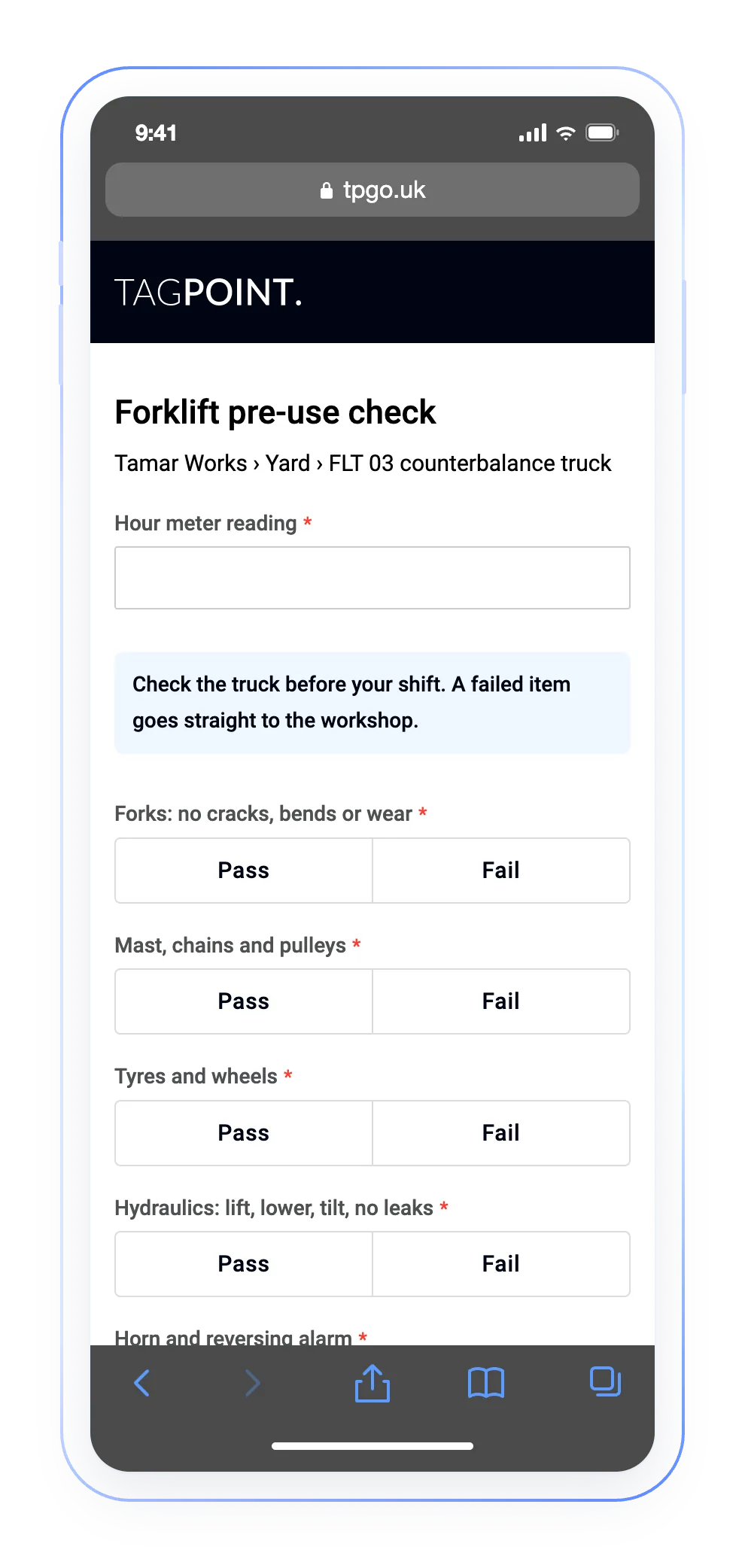
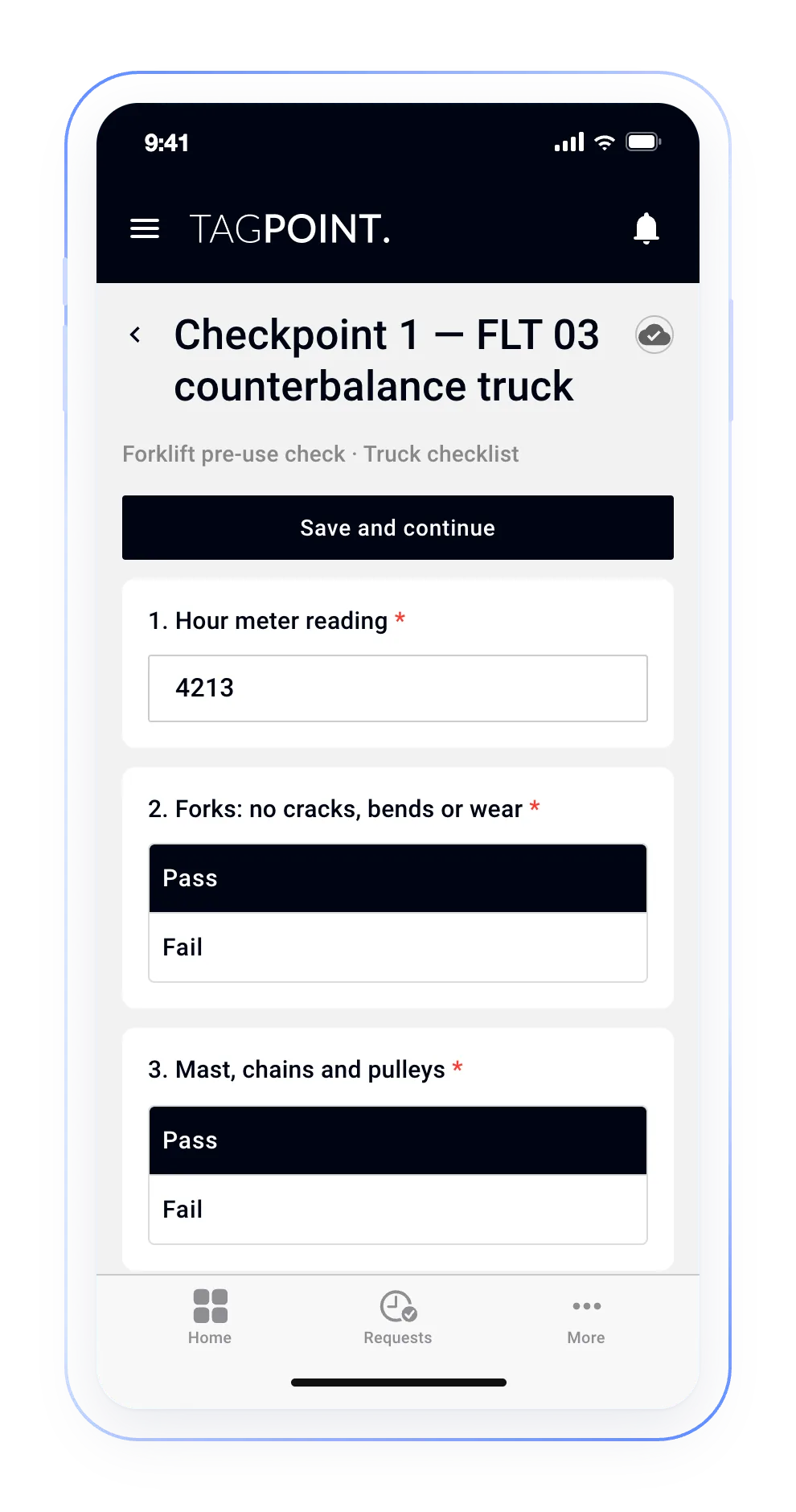
Scanning a truck's label opens its checks; the pre-use check is answered item by item
Checks on a schedule. A start-of-shift check per truck, or a daily check per machine, is set up as a recurring check with a deadline, assigned to a person or a role. A check that is not done shows up as overdue that shift, and a manager is told.
One log for managers. Every check is listed with the operator, the machine, the time and the number of failed items. You can print any check as a record or export report tables to Excel.
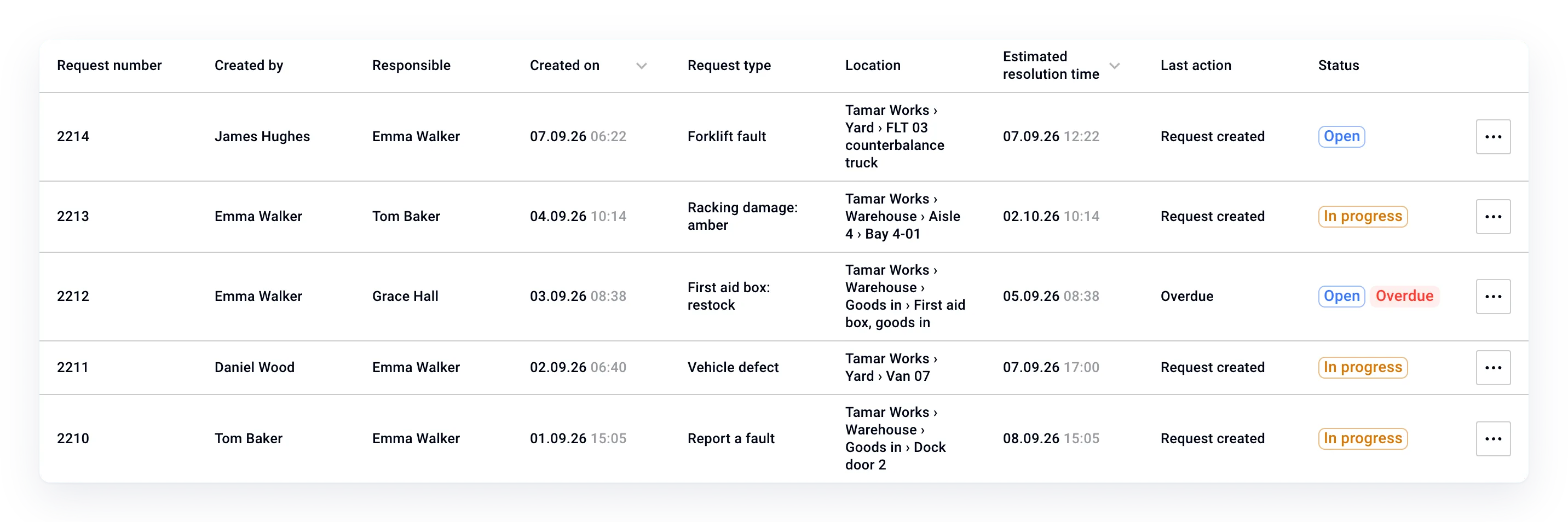
Faults from pre-use checks in one list, with owners and deadlines
Three habits make the difference in the first month:
- Fix the first faults fast and say so. Operators keep reporting when they see something happen.
- Look at failed items daily, not at the end of the week.
- Prune the questions. If an item has never failed in a month and can't really fail, take it out and keep the check short.
Read more about forklift and plant checks, machine safety checks or how TagPoint fits manufacturing.